Pirate Sites Colored Icons: Design Assets for Creators
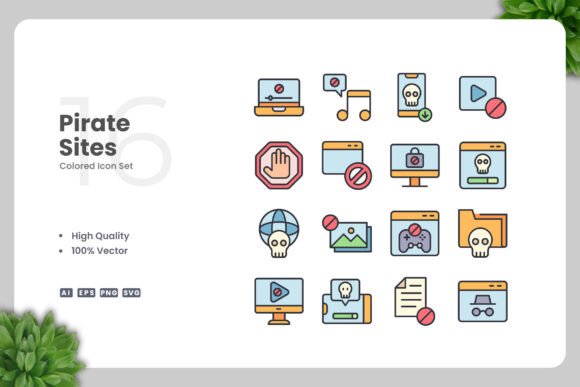
Every creative project needs a visual anchor—something that communicates mood, theme, or purpose without a single word. Pirate Sites Colored Icons deliver exactly that: a collection of bold, illustrated symbols with a pirate theme, rendered in clean vector format and ready for immediate use. Whether you are building a mobile app interface, designing a social media campaign, or laying out an infographic, these icons bring personality without clutter.
The set is built around a simple premise: high-quality, 100% vector graphics that you can resize, recolor, and rearrange without losing sharpness. Files come in Ai, EPS 10, SVG, and PNG formats, plus a transparency-ready option for layering. A readme file is included for quick setup. The design stays consistent across all assets, so your project keeps a unified look from start to finish.
What Makes These Icons Useful for Designers and Marketers
Vector graphics are the backbone of flexible design. Unlike raster images that pixelate when scaled, vectors hold their crisp edges at any size. That means you can use pirate-themed icons on a poster one day and shrink them for a mobile notification badge the next—no need to rebuild artwork.
The colored approach adds another layer. Each icon comes with a predefined palette that fits the pirate theme: deep blues, warm golds, reds, and earthy browns. You can keep these colors for a ready-made look or override them in software like Adobe Illustrator or CorelDRAW to match your brand guidelines. This flexibility matters when you work across multiple platforms that demand consistent color schemes.
Drag-and-drop support in the included files makes integration smooth. Open the SVG or Ai file, select the icon you need, and place it directly into your layout. No re-linking, no missing fonts, no broken paths. For time-sensitive projects, this efficiency is a real advantage.
Creative Applications Across Formats and Platforms
Versatility is where this icon set shines. Because the design is simple and clean, it adapts to both digital and print environments without looking out of place.
Websites and Mobile Apps
Navigation bars, call-to-action buttons, category headers, and empty-state illustrations all benefit from distinctive icons. A pirate skull marks a "danger zone" section in a dashboard. A treasure chest indicates premium content. A compass points to a sitemap or location feature. The colored style adds visual interest without overwhelming the interface—an important balance when user attention is scarce.
For mobile apps, SVG files allow retina-ready display on any screen density. Because the icons are vectors, you can also animate them using web tools or app frameworks, turning a static anchor icon into a subtle loading indicator or a ship into a progress marker.
Social Media Content
Social feeds are crowded. Posts with strong visual cues get noticed faster. Pirate-themed icons work well for themed campaigns, seasonal promotions, or brand storytelling. A series of posts about "navigating" a product launch could use a compass icon. A giveaway announcement could feature a treasure chest. The colored style pops against both light and dark backgrounds, which helps on platforms where autoplay and quick scrolling dominate.
You can also use icons as bullet points in carousel posts, as accent graphics in Instagram Stories, or as recurring elements in a branded template series. Consistency across posts builds recognition, and a dedicated icon set makes that consistency effortless.
Infographics and Print Materials
Infographics rely on visual shorthand to communicate data without paragraphs. A pirate flag icon can represent "warning" or "caution" in a statistical chart. A map icon anchors location-based data. A ship icon can illustrate growth or movement trends. Because the icons are colored, they double as legend markers—readers can match icon color to chart color for quick scanning.
Print applications include flyers, brochures, posters, and banners. The high-resolution PNG files handle 300 DPI printing without artifacts, and the EPS files give print shops exactly what they need for large-format output. A themed event poster, a library reading program flyer, or a retail sale banner all become more engaging with a cohesive visual language.
Adapting the Set for Different Audiences and Goals
Not every project calls for the same tone. The pirate theme can lean playful, educational, or even sophisticated depending on how you apply it.
For a children's book or educational app, keep the default colors bright and the shapes simple. The clean design is inherently friendly, making it suitable for young audiences. You might pair icons with large text and generous whitespace to support early readers or non-native speakers.
For a business presentation or professional landing page, mute the color saturation slightly or replace the palette with brand-specific hues. A silver and navy scheme still reads as nautical but feels polished rather than cartoonish. The vector source files make global color changes a matter of seconds.
For a hobbyist project like a tabletop game, a blog header, or a custom planner layout, mix and match icons to create your own composition. Because all files are layered and editable, you can combine elements, resize them, and add text without breaking the original design integrity.
Practical Recommendations for Getting the Best Results
Working with vector icons is straightforward, but a few habits will keep your output clean and professional.
- Organize your layers. In Illustrator or CorelDRAW, keep each icon on a separate layer or group. This makes it easier to find, edit, and export specific assets later.
- Use consistent stroke weights. If you modify an icon, try to match the line thickness of other icons in the set. Uniform stroke weight keeps the collection feeling cohesive.
- Test colors on multiple backgrounds. What looks vibrant on white might blend into a busy photo or a dark gradient. Use the PNG transparency file to preview your icons over the actual background you plan to use.
- Scale in multiples. When resizing vectors, scale by whole percentages (200%, 50%) rather than arbitrary decimals. This helps maintain proportion and avoids unexpected distortion.
- Save a working copy. Keep the original source files untouched. Duplicate the Ai or EPS file before making global changes, so you always have a fallback.
These practices are especially useful when collaborating with a team. A shared library of well-organized vector files means everyone works from the same visual vocabulary, which speeds up production and reduces revision cycles.
Ideas for Going Beyond Basic Placement
Once you are comfortable with the basics, consider pushing the icons into new contexts.
- Create a custom pattern. Duplicate a small icon like the star or coin and tile it across a background for a subtle texture. Use low opacity to keep it from competing with foreground content.
- Combine with typography. Place an icon inside a headline letter using a clipping mask, or use an icon as a drop cap at the start of a paragraph. This technique works well for book layouts and editorial design.
- Build an icon system. Expand the set by creating your own variants in the same style. Copy an icon's color palette and stroke properties, then draw new symbols that fit your project. Over time, you develop a custom library that feels unique while staying consistent.
- Animate for digital use. Export icons as SVG and add CSS animations or Lottie motion. A gentle rocking ship or a flickering lantern adds life to a web page without heavy performance cost.
These approaches work because the base design is neutral enough to support creative experiments but defined enough to keep results coherent. You are not starting from a blank page—you are building on a foundation that already has proven visual logic.
Who Benefits Most from This Icon Set
Freelancers juggling multiple clients get a consistent asset that works across diverse briefs. Small business owners who manage their own marketing can produce professional-looking materials without hiring a designer for every flyer or post. Educators and publishers can create handouts and digital content that capture attention without looking generic. Hobbyists exploring new creative outlets can experiment without investing hours in drawing original icons from scratch.
The common thread is a need for efficient, high-quality visuals that do not require deep technical skills to customize. Pirate Sites Colored Icons remove the barrier of drawing ability and let you focus on layout, messaging, and audience fit.
Whether you are designing for a pirate-themed event, a navigation-focused app, or a brand that wants to signal adventure and discovery, this collection gives you a head start. The files are ready to download, open, and place. From there, your project takes shape quickly—and that is the point. Good design tools should accelerate your workflow, not slow it down with unnecessary complexity.
Upnowgraphic has structured the set for real-world use: vector format for infinite scalability, multiple file types for compatibility, and a clean style that resists trend-driven obsolescence. Use the icons as they are, or make them your own. Either way, they earn their place in your creative toolbox.