The Complete Guide to Food Packaging Colored Icons: Design, Usage, and Best Practices
In today's visually driven world, icons have become a universal language that transcends barriers and communicates ideas instantly. Among the most versatile and widely used visual elements are food packaging colored icons. These small yet powerful graphics are essential for websites, mobile apps, books, social media, infographics, flyers, print materials, banners, posters, and countless other applications. Whether you are a designer, business owner, marketer, or content creator, understanding how to leverage these icons can elevate your projects and improve audience engagement.
What Are Food Packaging Colored Icons?
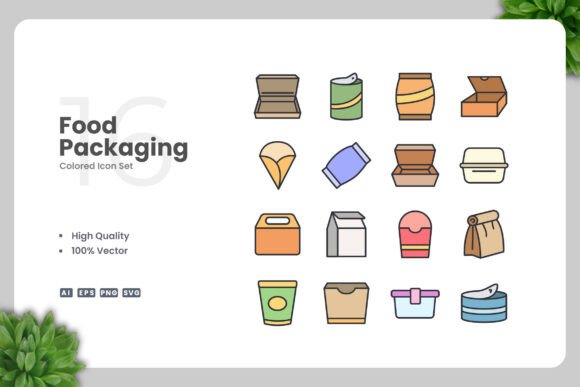
Food packaging colored icons are simplified, visually appealing graphics that represent concepts related to food storage, preparation, packaging, and consumption. They often depict items such as containers, bottles, cans, boxes, labels, utensils, and freshness indicators. These icons are typically designed with a simple and clean aesthetic, making them easy to recognize at a glance while still conveying specific meanings.
The colored aspect adds an extra layer of communication. Colors can indicate freshness (green for organic), urgency (red for warnings), or category (blue for beverages, yellow for snacks). When used effectively, colored icons help users navigate information quickly and intuitively, which is especially important in digital environments where attention spans are short.
Why Simple and Clean Design Matters
A common misconception is that icons need to be highly detailed to be effective. In reality, less is often more. Simple and clean designs reduce cognitive load, allowing viewers to process the icon's meaning in milliseconds. This is particularly important for food packaging icons, which may appear in contexts where clarity and speed are essential—such as on a restaurant menu app, a grocery delivery website, or a nutrition label infographic.
Clean icons also scale better across different mediums. An icon that looks great on a desktop screen should also be legible on a mobile device, a printed flyer, or a large banner. Simplified shapes, consistent stroke widths, and harmonious color palettes ensure that the icon remains recognizable regardless of size or resolution.
Moreover, clean designs are more accessible. People with visual impairments or color blindness can still distinguish icons based on shape and contrast when clutter is minimized. This aligns with modern design principles like inclusivity and universal usability.
The Purpose and Significance of Food Packaging Icons
Food packaging icons serve several important functions across various fields:
- Communication: They quickly convey information about food safety, storage instructions, ingredients, or recycling guidelines without relying on text.
- Branding: Consistent icon styles help establish brand identity and make packaging or marketing materials instantly recognizable.
- User Experience: In apps and websites, icons guide users through navigation, filter options, and product categories with minimal friction.
- Education: In books and infographics, they simplify complex concepts like food preservation methods or nutritional values.
- Marketing: Eye-catching icons draw attention to promotions, special offers, or product features on posters, banners, and social media posts.
In modern life, these icons appear everywhere—from the "microwave safe" symbol on a takeout container to the "recycle" graphic on a soda can. Their ubiquity speaks to their practical relevance in helping people make informed decisions quickly.
Websites and Mobile Apps
For e-commerce platforms, recipe sites, and food delivery services, icons streamline the browsing experience. A search filter with icons for "gluten-free," "vegan," "organic," or "microwaveable" allows users to refine results without reading long lists of text. Mobile apps, in particular, benefit from icons because screen real estate is limited. A simple container icon paired with a color-coded freshness indicator can communicate at a glance whether a product is perishable or shelf-stable.
Social Media and Infographics
Social media posts with icons see higher engagement because they break up text-heavy content. An infographic about food waste reduction, for example, can use icons to illustrate steps like "store properly," "use leftovers," and "compost." On platforms like Instagram, Pinterest, and LinkedIn, visually appealing icons help stop the scroll and convey key messages quickly.
Print Materials: Flyers, Banners, and Posters
Printed materials have unique constraints—they cannot rely on hover effects or animations. Icons must communicate clearly in static form. Food packaging icons on a flyer for a farmers' market booth can highlight "fresh," "locally sourced," and "organic" without needing extra text. The simplicity of clean icons ensures they remain sharp and legible when printed on different paper stocks and sizes.
Books and Educational Resources
In cookbooks, nutrition guides, and food science textbooks, icons help organize information and aid memory. A color-coded icon system for different food groups or cooking methods makes complex material more approachable for beginners while still being useful for experienced readers.
Customization: The Key to Versatility
One of the standout features of high-quality food packaging colored icons is that they are 100% customizable. Because they are provided as vector files, you can easily resize, recolor, and edit them to fit your specific needs. This is a game-changer for designers and non-designers alike.
Vector graphics use mathematical equations rather than pixels, which means they can be scaled infinitely without losing quality. Whether you need a tiny icon for a mobile button or a giant icon for a billboard, vector files maintain sharp edges and vivid colors.
How to Edit Icons in Vector Software
Programs like Adobe Illustrator and CorelDRAW are industry standards for vector editing. With these tools, you can:
- Change colors to match your brand palette or seasonal campaign.
- Adjust stroke thickness for better visibility at different sizes.
- Combine or separate elements to create new icons.
- Export to any format you need, including PNG, SVG, or EPS.
For beginners, the learning curve is manageable. Many tutorials are available online, and the included Readme.txt file often provides quick-start instructions. The ability to drag and drop files directly into design software makes the process even smoother.
What to Look for in a Quality Icon Set
Not all icon sets are created equal. When choosing food packaging colored icons for your project, consider the following features:
- High Quality Design: The icons should be visually consistent, with balanced proportions and harmonious colors.
- 100% Vector Format: Ensure the set includes source files like AI (Adobe Illustrator) and EPS (Encapsulated PostScript) version 10 or higher.
- Scalability: Icons should look great at any size, from 16x16 pixels to 1000x1000 pixels.
- Multiple File Formats: Look for SVG (for web), PNG with transparency (for quick use), and EPS (for backward compatibility with older software).
- Easy Customization: The ability to edit colors, strokes, and shapes without damaging the original design is essential.
- Clear Naming and Organization: Files should be logically named and grouped for easy navigation.
Sets that include a Readme.txt file with instructions are especially helpful for users who may be new to vector editing. This small addition shows that the creator values usability and customer experience.
Common Misunderstandings About Vector Icons
There are a few myths that can lead to frustration if left unaddressed:
Myth 1: "Vector icons are only for professional designers."
While vector software does have a learning curve, basic editing—like changing a color or resizing—can be learned in minutes. Many tools also offer free alternatives like Inkscape or Vectr that work with SVG files.
Myth 2: "Icons must be completely unique to be effective."
Uniqueness is valuable for branding, but clarity is more important. A well-designed icon that follows familiar visual conventions (like a fork and knife for "restaurant") will be understood immediately. You can always customize colors and details to make it your own.
Myth 3: "More colors make icons better."
Too many colors can overwhelm the viewer and reduce recognizability. A clean palette of two to four complementary colors is usually sufficient to convey meaning and maintain visual harmony.
How Food Packaging Icons Fit Into Modern Workflows
In today's fast-paced content creation environment, efficiency matters. Businesses often need to produce materials for multiple channels simultaneously—a social media post, a website banner, a printed flyer, and an email newsletter. Having a single set of versatile icons that works across all these formats saves time and ensures brand consistency.
For example, a grocery delivery service might use the same "fresh produce" icon on its mobile app icon, its Instagram story, its website homepage, and its weekly print flyer. Because the icon is vector-based, it can be resized, recolored, and formatted for each medium without starting from scratch. This workflow efficiency is one of the main reasons why high-quality icon sets are a worthwhile investment.
Tips for Getting the Most Out of Your Icon Set
To maximize the value of your food packaging colored icons, consider these practical tips:
- Start with a strategy: Decide which icons you need based on your content goals. Avoid using icons just for decoration; each icon should serve a clear purpose.
- Maintain consistency: Stick to one icon style throughout a project. Mixing flat icons with 3D icons or line art with filled shapes can look disjointed.
- Test on different backgrounds: An icon that looks great on white may disappear on a busy pattern. Always check contrast and consider adding a subtle shadow or outline if needed.
- Use transparency wisely: PNG files with transparency allow icons to overlay seamlessly on any background, but make sure the edges are clean and aliasing is minimized.
- Document your customizations: If you adjust colors or shapes, keep a record so you can replicate the changes across your team or future projects.
The Future of Food Packaging Icons
As visual communication continues to evolve, icons will remain a cornerstone of effective design. With the growing emphasis on sustainability and transparency in food packaging, icons that communicate eco-friendliness, recyclability, and ethical sourcing are becoming more important. Designers who master the art of simple, clean, and colorful iconography will be well-positioned to meet the needs of both consumers and businesses.
Moreover, the rise of augmented reality (AR) and interactive packaging may soon integrate icons that users can scan with their phones for additional information. This will require icons that are not only visually clean but also technically compatible with digital scanning tools.
Conclusion
Food packaging colored icons are far more than decorative elements—they are powerful communication tools that enhance usability, branding, and engagement across virtually every medium. Their simple and clean design makes them accessible to all audiences, while their vector format ensures endless customization possibilities. Whether you are designing a website, a mobile app, a social media post, an infographic, a flyer, or a poster, having a reliable set of high-quality icons can streamline your workflow and elevate your final product.
By choosing icons that are 100% vector, easily editable, and available in multiple formats (AI, EPS, SVG, and PNG), you invest in a resource that will serve you for years to come. With the right tools and a little creativity, you can adapt these icons to fit any project, audience, or brand identity. So go ahead—explore, customize, and create. Your next project will thank you.