Radio Colored Icons: Practical Vector Assets for Clean, Consistent Design Workflows
Design resources that combine simplicity with utility rarely go out of style. Radio Colored Icons offer a straightforward collection of vector-based icons built around a clean, minimal aesthetic with carefully applied color. Whether you are planning a website interface, preparing a social media campaign, or assembling a printed brochure, having a reliable set of icons that can be adapted on the fly saves time and preserves visual consistency. This article explores what these icons are, where they fit into real project workflows, and how to get the most out of them from preparation through final delivery.
What Radio Colored Icons Bring to Your Creative Process
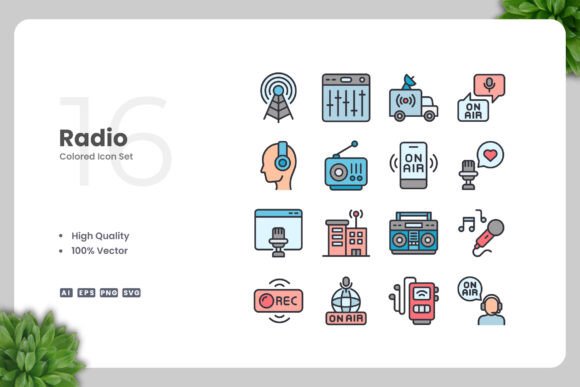
At its core, this icon set delivers 100 vector graphics designed in a style that balances clarity with a subtle use of color. The icons avoid unnecessary ornamentation, making them suitable for contexts where the message needs to come through without visual noise. The colored treatment adds a layer of polish that works well on both light and dark backgrounds, and the consistent style across the set helps maintain a unified look across multiple assets.
The practical value becomes clear when you consider the range of output formats and the level of control you retain. The set includes source files in Adobe Illustrator (AI) and EPS Version 10 formats, along with SVG files for web use and PNG files with transparency for quick placement. This combination means you can use the icons directly in a presentation, embed them in a mobile app prototype, or refine them further in vector software. The included Readme.txt provides basic reference information, so you are never guessing about file structure.
Planning and Preparation Phase
Before you start designing, having a library of icons that you know will work across different media simplifies early decisions. During the planning stage, you can browse the set to identify which icons align with the content categories you need—whether that is communication, media, technology, or general interface elements. Because the icons are already colored and styled consistently, you can use them in wireframes or mood boards to give stakeholders a realistic preview of the final visual direction. This reduces the need to create placeholder graphics or search for alternatives later.
For example, if you are mapping out a mobile app that includes features like radio streaming, podcast playback, or music discovery, the Radio Colored Icons set likely contains symbols that match those functions. You can drop them into early mockups without worrying about licensing or attribution, which keeps the focus on layout and user flow.
During Active Design and Development
When you move into the production phase, the ability to customize each icon becomes a major advantage. Because the files are vector-based, you can open them in Adobe Illustrator or CorelDRAW and adjust colors to match your brand palette. You can also resize them without losing quality, which matters when you need a small icon for a button and a larger version for a hero section. The SVG files work well for web teams who prefer to manipulate icons directly in code, while the PNG transparency files give developers a ready-to-use option for rapid prototyping.
In a typical workflow, a designer might open the AI source file, select an icon group, and apply a new color swatch to align with client guidelines. The same icon can then be exported at multiple sizes for different breakpoints. Because the set includes 100 unique icons, you can build an entire interface without introducing visual inconsistency. This consistency also helps when handing off files to developers, because they know all icons follow the same structural logic.
Post-Launch Updates and Long-Term Use
Projects rarely end at launch. Over time, you may need to update marketing materials, refresh a website, or create new content for social media. Having a vector icon set that you can reopen and edit months later is a practical advantage. The EPS Version 10 format ensures backward compatibility with older versions of design software, and the AI files keep layers intact so you can quickly find and modify specific elements. If your brand evolves or you need to introduce a new accent color, you can update the entire icon set in one session rather than redoing each graphic from scratch.
For content creators and educators who produce recurring materials like newsletters, ebooks, or course slides, this reuse potential is especially valuable. You can maintain a consistent visual language across multiple publications without starting over each time.
Preparation and File Organization
Before you begin editing, take a few minutes to organize the files in a way that fits your project structure. Copy the AI and EPS folders into your assets directory, and keep the SVG and PNG subfolders accessible for web and development teams. Rename the icon files using a naming convention that matches your project taxonomy, such as icon-radio-color.svg or icon-music-color.ai. This small step prevents confusion later, especially when working with a set of 100 icons across multiple output formats.
If you work with a team, create a shared library or cloud folder that contains the original source files along with any modified versions. That way, everyone pulls from the same base set, and you avoid the problem of outdated or mismatched icons appearing in different parts of a project.
Editing in Vector Software
Both Adobe Illustrator and CorelDRAW handle this icon set well. When you open an AI file, you will typically find each icon grouped logically, with shapes and colors separated on individual layers. To change the color of an icon, select the group and use the Recolor Artwork dialog in Illustrator, or apply a new fill in CorelDRAW. Because the icons use flat color fills, you can achieve consistent results quickly.
If you need to resize an icon, hold the Shift key while dragging a corner handle to maintain proportions. For SVG files, you can adjust the width and height attributes directly in a text editor or use a vector tool to scale the graphic. The PNG files come at a preset size, but you can reference them for placement while using the vector versions for final refinement.
Integration with Other Tools and Platforms
These icons are not limited to a single workflow. You can import the SVG files into prototyping tools like Figma, Sketch, or Adobe XD to build interactive mockups. The PNG files work in presentation software like PowerPoint or Google Slides for corporate decks. For print projects such as flyers, posters, and banners, the EPS and AI formats ensure that images remain crisp at any output resolution. If you produce infographics for social media, you can copy an icon directly from the vector file, paste it into your layout software, and scale it without pixelation.
For web developers, the SVG files offer the advantage of being lightweight and scalable. You can embed them directly in HTML, style them with CSS, or use JavaScript to change colors dynamically. This flexibility makes the set suitable for responsive designs where icon size and color need to adapt to different screen contexts.
Maintaining Consistency Across Projects
One of the strongest arguments for using a dedicated icon set like Radio Colored Icons is the consistency it enforces across different types of content. When your website, mobile app, social media graphics, and printed materials all share the same icon style, your brand feels more cohesive. To maintain this consistency, establish a simple rule: always start from the original vector source when you need a new icon version. Avoid saving rasterized copies unless absolutely necessary, because once an icon is flattened, you lose the ability to edit colors or scale it cleanly.
If you find yourself frequently adjusting the same icon for different contexts, consider creating a master template file that includes all 100 icons arranged on a grid. This grid file can serve as a visual reference for your team, and you can export individual icons as needed without opening multiple files.
Quality Control and Long-Term Value
The quality of vector assets directly affects the quality of your final output. With Radio Colored Icons, the vectors are built with clean paths and consistent stroke weights, which means you are unlikely to encounter broken curves or stray anchor points. This attention to detail reduces troubleshooting time during production. To ensure you maintain this quality, always preview icons at different sizes before finalizing a layout. What looks good at 200% zoom may appear too detailed at a small size, or vice versa. Because these icons follow a simple design philosophy, they tend to scale well, but it is still good practice to check.
From a long-term perspective, a vector icon set that you can edit, recolor, and resize gives you a reusable resource that adapts to changing needs. Unlike bitmap graphics that become obsolete when resolutions increase, vector files remain future-proof. And because the set includes standard formats like SVG and EPS, you can open them in almost any modern design environment.
Final Observations on Workflow Integration
Radio Colored Icons fill a specific niche: they offer colored, clean vector graphics that work immediately in a wide range of projects, but also give you full control to customize them when needed. For professionals who value efficiency, this dual nature reduces friction. You can use the icons as-is for quick deliverables, then refine them later if the project demands a unique look. This flexibility is especially useful for freelancers and small business owners who manage multiple projects with different branding requirements.
If you are a marketer planning a campaign, a developer building an app interface, an educator creating course materials, or a blogger producing consistent visual content, having a reliable icon set simplifies your workflow. The preparation work is minimal—organize the files, open them in your preferred vector software, and start placing them into your layouts. The real value emerges when you need to iterate quickly, update colors for a new brand guide, or scale an icon from a mobile screen to a banner poster without losing clarity.
Ultimately, the best design resources are the ones that stay out of your way and let you focus on the message. Radio Colored Icons achieve that by combining simplicity with adaptability, making them a practical addition to any creative toolkit.