Presentation Colored Icons: Simple and Clean Design for Every Project
When you are building a brand, crafting a social media campaign, or designing a user interface, the quality of your visual assets can make or break the final result. Icons, in particular, carry a surprising amount of weight. They guide users, add clarity, and reinforce your message without using extra words. Presentation Colored Icons offer a straightforward solution for anyone who needs polished, consistent visuals that work across multiple platforms. Whether you are a marketer preparing a pitch deck, a developer adding interface elements, or a small business owner creating a flyer, this icon set can save time and keep your work looking cohesive.
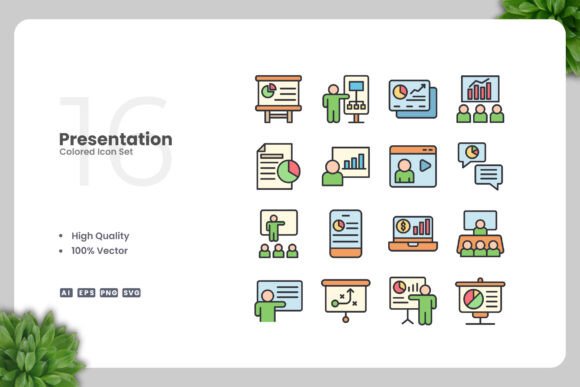
What makes this set stand out is its emphasis on simplicity and clean design. Each icon is built with clear outlines, balanced proportions, and a consistent color palette. You do not get distracting gradients or overly complex shapes. Instead, you get assets that scale easily and integrate smoothly into any layout. The result is a collection that works well whether you are using it for a website, a mobile app, a book, social media graphics, infographics, flyers, print materials, banners, or posters. In short, it is a versatile tool designed for real projects, not just mockups.
Where Presentation Colored Icons Fit in Your Workflow
One of the strongest advantages of this icon set is how it can be used at multiple stages of a project. Instead of being locked into a single use case, you can pull these icons into your process before, during, or after your main creation work.
Before the Project: Planning and Storyboarding
During the planning phase, you often need to communicate ideas quickly. Wireframes, mood boards, and concept sketches benefit from placeholder imagery that looks professional. Presentation Colored Icons give you a library of 100 vector symbols that you can drop into early drafts. Because they are fully customizable in vector software like Adobe Illustrator and CorelDRAW, you can adjust their size and color to match your brand guidelines before you even start building the final asset. This kind of low-fidelity testing helps you see how icons will support your overall layout and message, saving you from redesigns later.
During the Project: Active Design and Development
When you are actively designing a website, app interface, or print piece, having ready-to-use icons accelerates your workflow. The drag-and-drop nature of the files included helps you move quickly. The source files are provided in AI, EPS Version 10, SVG, and PNG formats. That means whether you work in Adobe Illustrator, Inkscape, Affinity Designer, or even a presentation tool that supports SVG, you can bring these icons in without conversion headaches. For mobile app designers, the PNG transparency is particularly useful for inserting icons directly into interface mockups or coding environments. For print designers, the vector formats ensure that your icons remain sharp at any resolution, whether they appear on a small business card or a large poster.
After the Project: Refinement and Versioning
Even after your main design is finished, you may need to iterate. A client asks for a different color scheme. A new social media campaign requires a slight variation of your existing visuals. Because every icon in Presentation Colored Icons is 100% customizable, you can open the vector files and adjust the color, stroke weight, or even the shape in a few clicks. This flexibility is especially valuable for professionals who manage multiple brand identities or frequently update their materials. Instead of commissioning or searching for new icons each time, you have a single, editable source file that evolves with your needs.
Practical Implementation and Integration
Getting started with Presentation Colored Icons is straightforward, but there are a few practices that can make your workflow even smoother.
Organize Your Files
When you download the set, you will find structured folders: one for AI, one for EPS, one for SVG, and one for PNG (with transparency). Create a master folder on your project drive and keep the readme.txt file handy for quick reference. If you work with a team, consider naming your files consistently using categories (e.g., icon-business-01.ai) so everyone can find what they need. This organization pays off when you reuse icons across multiple projects months later.
Customize with Vector Software
To resize or change colors, open the AI or EPS file in Adobe Illustrator or CorelDRAW. The icons are composed of separate, grouped layers. You can select any individual icon, adjust the fill or stroke color to match your palette, and then export it for your specific use. For example, if you need a set of icons for a mobile app, you might change all colors to your brand’s primary blue and secondary orange. For a print flyer, you might need them in grayscale or a single accent color. The process is the same: open, select, edit, save. Because the files are vector, you never lose quality when scaling from a tiny social media icon to a full-page poster background.
Use SVG for Web and Digital
The SVG files are ideal for web design. You can embed them directly into HTML, or import them into tools like Figma, Sketch, or Adobe XD. Because SVGs are code-based, you can even change their colors using CSS, which gives developers extra control without needing to open Illustrator. For digital workflows such as interactive PDFs or ebook layouts, SVG provides crisp rendering on all screen sizes. The included PNG files with transparency are perfect for situations where you cannot use SVGs, such as certain email clients or older presentation software.
Combine with Other Assets
Icons rarely exist in isolation. Presentation Colored Icons work well alongside other design assets like photos, illustrations, typography, and data visualizations. Because the icons have a simple and clean style, they do not clash with more detailed imagery. Use them as bullet points in a list, as visual anchors in infographics, as navigation elements on a website, or as decorative elements in a banner. Their consistency helps maintain a unified look across your entire project.
Tips for Long-Term Use and Efficiency
Once you integrate Presentation Colored Icons into your asset library, you can rely on them for future work. But to get the most value over time, keep these points in mind.
Build a Reusable Library
After you customize an icon to your brand, save that version in a dedicated folder. Over the course of several projects, you will build a library of branded icons that you can drop into any new file instantly. This approach reduces repetitive work and ensures consistency across all your communications.
Check Compatibility Early
While the set includes multiple file formats, always verify that the software you or your team uses can open the EPS Version 10 files. Most modern vector editors handle EPS well, but if you are working with a niche tool, the SVG format is usually the safest fallback. The readme.txt file includes basic instructions, so reviewing it before you start can save you a few minutes of trial and error.
Plan for Scale
Because the icons are vector, you can use them in small sizes (16x16 pixels for favicons) and large sizes (full banner area for a trade show poster). Keep the original vector file untouched and generate the needed sizes on demand. This preserves the source and prevents pixelation.
Quality Control in Team Settings
If you work with a team of designers or marketers, set up a simple naming convention and a shared folder for the icon set. Include the readme.txt file for reference. When someone needs an icon for a new flyer or social media post, they can quickly grab the appropriate format and color version. This reduces redundant creation and maintains brand standards across the team.
Conclusion: A Reliable Asset for Creators and Professionals
Presentation Colored Icons deliver on the promise of simple, clean design that fits into many workflows. Whether you are preparing a pitch deck, finalizing a mobile app interface, designing a printed brochure, or creating infographics for social media, these icons give you a solid starting point. The emphasis on high-quality vector construction, easy customization, and multiple file formats means you can spend less time hunting for assets and more time on the creative decisions that matter. For entrepreneurs, freelancers, marketers, educators, and anyone who regularly produces visual content, this set offers practical value without unnecessary complexity.
By integrating Presentation Colored Icons into your process, you gain a consistent visual language that works across projects. You save time during planning, maintain flexibility during active design, and simplify updates after launch. And because you can resize, change colors, and edit the files in standard vector software, you are never locked into a single look. The result is a tool that adapts to your needs, not the other way around.
Thanks for reading. Have a great day. Upnowgraphic.