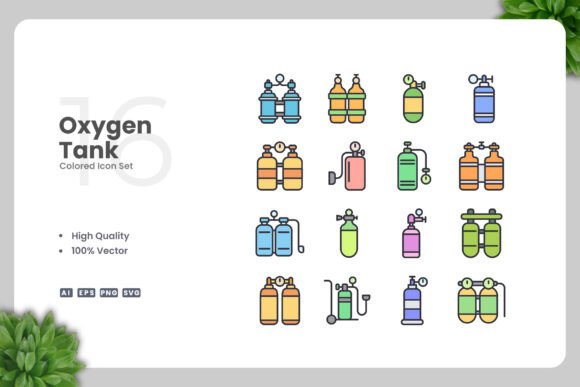
Oxygen Tank Colored Icons: When Simple Design Meets Real-World Versatility
There is something quietly powerful about an icon that does exactly what it needs to do and nothing more. Oxygen Tank Colored Icons fall into that rare category of design assets that feel both purposeful and effortless. Whether you are building a healthcare app, designing a poster for a wellness event, or putting together a social media campaign around respiratory health, these icons offer a clean visual shorthand that speaks immediately to your audience. They are not flashy. They do not try to impress with unnecessary complexity. Instead, they do the hard work of communicating clearly, which is exactly what you need when your message matters.
What makes this set particularly interesting is how deliberately simple it is. Every icon in the collection follows a consistent visual language, with soft edges, balanced proportions, and a restrained color palette that feels modern without being trendy. That means it ages well. A flyer you design today with these icons will still look current two years from now, which is more than you can say for many design resources. The icons are built for longevity, and that alone makes them worth a closer look.
Where Oxygen Tank Colored Icons Fit Into Everyday Work
Think about the last time you needed to explain something medical or technical without using words. Maybe you were designing an infographic about oxygen therapy for a clinic waiting room. Or perhaps you were putting together a presentation on respiratory health for a community workshop. In both cases, the visuals needed to be accurate enough to convey the right meaning, but simple enough that anyone could understand them at a glance. That is exactly the sweet spot these icons occupy.
Let me walk you through a few real-world scenarios where this collection genuinely shines.
Healthcare and Medical Communication
Hospitals, clinics, and health-tech companies are always looking for visual assets that feel professional without being cold or clinical. Oxygen Tank Colored Icons work well here because they strike a balance between technical clarity and human warmth. A pulmonary rehabilitation center might use them on patient handouts to illustrate different types of oxygen delivery systems. A home healthcare agency could include them in an onboarding brochure for new patients who need to understand equipment basics. The icons make the information feel less intimidating, which matters a great deal when people are already anxious about their health.
One observation I have made is that medical professionals often struggle to find icons that look like they belong in a professional setting rather than a childrens book. These icons avoid that trap entirely. They are clean enough for a hospital intranet portal but still approachable enough for a community health fair poster.
Wellness and Fitness Content
It might surprise you to see oxygen tank icons in a fitness context, but they actually fit naturally. High-altitude training studios, breathing workshops, and yoga retreats all use imagery related to oxygen and breathwork. A fitness app that includes breathing exercises could use these icons to mark different breathing techniques or to indicate oxygen-related metrics. A brand that sells altitude training masks might use them on product packaging or in instructional materials. The icons bring a sense of authority and clarity to content that might otherwise feel abstract or hard to visualize.
I have noticed that wellness audiences tend to respond well to visuals that feel clean and unfussy. These icons deliver exactly that. They do not compete with the content; they support it.
Educational Materials and Books
Textbooks, e-books, and online courses about respiratory health, chemistry, or emergency medicine all benefit from consistent iconography. Oxygen Tank Colored Icons can serve as chapter markers, callout symbols, or visual cues in diagrams. An online course about first aid might use them to indicate when oxygen administration is relevant. A childrens science book about how lungs work could include them as part of a friendly, approachable illustration system. The adaptability here comes from the icons vector format, which means they scale perfectly whether you are using them in a printed textbook or a mobile learning app.
What I appreciate about using icons in educational content is how they reduce cognitive load. Readers do not have to read a paragraph to understand that an oxygen tank is involved; they see the icon and know instantly. That speed of recognition is invaluable in learning materials.
Infographics and Data Visualization
Infographics live and die by their visual clarity. If the icons are too detailed or too stylized, they distract from the data. If they are too generic, they fail to communicate. Oxygen Tank Colored Icons hit the middle ground nicely. You could use them as repeating visual elements in a statistics-heavy infographic about air quality or respiratory disease rates. The consistent coloring and simple shapes mean they integrate smoothly with charts, graphs, and text blocks without creating visual noise.
I have found that the best infographics use icons sparingly but deliberately. This set encourages that disciplined approach because each icon is self-contained and meaningful. You do not need to add extra decoration; the icon already tells the story.
Practical Strengths That Matter in Daily Use
Beyond the visual style, there are some practical features worth highlighting because they directly affect how easy or difficult your workflow will be.
- Vector format flexibility: Because every file is vector-based, you can resize the icons to fit a mobile app interface or blow them up to poster size without losing quality. That kind of scalability is non-negotiable if you work across multiple media types.
- Color customization: The included source files let you change colors in Adobe Illustrator or CorelDRAW with a few clicks. If your brand uses a specific teal or a particular shade of blue, you can match it exactly. This is especially useful when you are building a consistent visual identity across print and digital materials.
- Multiple file formats: Having AI, EPS, SVG, and PNG options means you are covered whether you are designing for the web, sending files to a printer, or sharing assets with a developer. The SVG files in particular are great for responsive websites because they stay crisp at any screen size.
- Drag and drop readiness: The files are organized so you can pull them directly into your project without extra setup. If you have ever spent twenty minutes resizing and repositioning icons that came in awkward formats, you will appreciate how much time this saves.
A quick observation about the included Readme.txt: it is a small touch, but it shows that the designer thought about the user experience. Having clear instructions for file usage reduces friction, especially if you are handing the files off to a team member who might not be as familiar with vector software.
Who Benefits Most from This Icon Set
The honest answer is that a wide range of people find value here, but some profiles stand out.
Freelance Designers and Small Agency Owners
If you are juggling multiple clients across different industries, you need assets that can adapt quickly. This icon set works for a hospital website one week and a fitness brands social media campaign the next. The simplicity of the design means you are not locked into a single aesthetic. You can customize the colors to match each clients brand guidelines, and the vector files make it easy to composite the icons into larger illustrations or layouts.
Content Creators and Social Media Managers
Anyone who produces content regularly knows how time-consuming it is to find visuals that are both relevant and licensed for commercial use. Oxygen Tank Colored Icons give you a reliable source of imagery for posts about health awareness days, respiratory care tips, or product features. The PNG transparency files are especially handy for quick social media graphics because you can drop them directly onto a colored background without needing to remove a background first.
Nonprofits and Community Organizations
Organizations that work in public health, environmental justice, or disaster relief often need to communicate complex information on limited budgets. These icons allow them to produce professional-looking materials without hiring a designer for every single project. A nonprofit focused on lung health could use the icons in grant proposals, community flyers, and website graphics, creating a cohesive look across all their communications.
A Few Things to Consider Before You Use Them
No resource is perfect for every situation, and being clear about limitations helps you make better decisions.
The icons are deliberately simple, which is their greatest strength and also a potential limitation for very specialized use cases. If you need extremely detailed technical illustrations, such as the internal mechanism of a specific oxygen tank model, these icons are not designed for that purpose. They work best as clear, recognizable symbols, not as engineering diagrams. That is a distinction worth keeping in mind when choosing the right visual approach for your project.
Another consideration is that the color palette, while clean and modern, may not match every brand out of the box. The good news is that the vector files make recoloring straightforward. Just be prepared to spend a few minutes adjusting hues if your brand has very specific color requirements. That said, the base colors are neutral enough that they complement most designs without clashing.
There is also the question of cultural context. Oxygen tanks and respiratory imagery carry different connotations in different parts of the world. In some communities, they may evoke medical emergencies or serious illness. In others, they are associated with athletic training or wellness. Consider your audience and how they might perceive the imagery before using it in sensitive contexts.
Making the Most of the Vector Files
If you are new to working with vector files, here is a practical tip: always keep a copy of the original AI or EPS file untouched. Make duplicates before you start customizing. That way, if you accidentally break something or want to revert to the original design, you have a clean starting point. The drag-and-drop ease of these files makes them forgiving for beginners, but a little caution goes a long way.
Another observation from experience: SVG files are fantastic for web use, but they can sometimes behave unpredictably in older content management systems. If you are adding the icons to a website, test them in a few different browsers to make sure they render correctly. The PNG files serve as a reliable fallback if you run into compatibility issues.
For print projects, the EPS version 10 format is a solid choice. It is widely supported by professional printing services and maintains the vector quality that keeps icons sharp on large-format materials like posters and banners.
Final Thoughts on Bringing These Icons Into Your Work
What stands out most about Oxygen Tank Colored Icons is how much thought went into making them useful across so many different contexts. They are not just a collection of pretty graphics. They are a practical toolkit for anyone who needs to communicate ideas about oxygen, respiratory health, or wellness with clarity and visual consistency. Whether you are designing for a hospital, a fitness brand, a classroom, or a social media feed, these icons give you a head start.
The best design tools are the ones you do not have to fight with. These icons let you focus on your message, your layout, and your audience, which is exactly what good design should do. If you are looking for a resource that balances simplicity, versatility, and professional quality, this set deserves a spot in your toolkit.