Natural Disaster Colored Icons: A Practical Guide for Designers and Content Creators
When you need to communicate urgency, safety information, or environmental awareness, the right visual language matters. A Natural Disaster Colored Icons set offers a ready-made solution for projects that require clear, emotionally resonant imagery. These vector-based illustrations cover events such as earthquakes, floods, hurricanes, wildfires, volcanic eruptions, and tornadoes, using color to add context and impact. But what makes such a set distinct, and how does it compare to other visual options like monochrome icons, custom illustrations, or photography? This article explores the strengths, limitations, and best-fit situations for using colored disaster icons, helping you decide when they serve your audience best.
What Defines a Natural Disaster Colored Icons Set
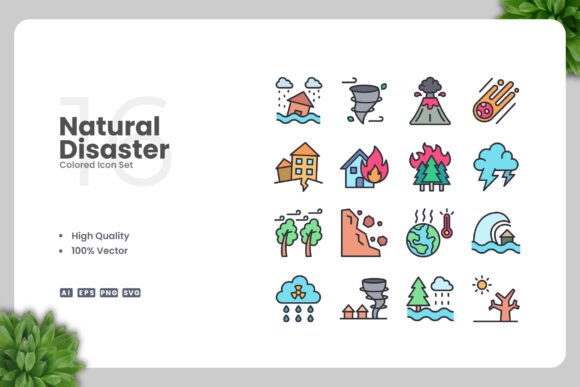
A dedicated icon set focused on natural disasters is built around thematic consistency. Unlike generic weather or emergency symbols, these icons aim to depict specific phenomena in a stylized but recognizable way. The use of color is intentional: reds and oranges signal fire or heat, blues and grays represent water or storms, and earthy tones indicate geological events. This palette helps viewers quickly grasp the type of disaster being referenced, even at small sizes.
The set described in the brief includes 100 vector icons, available in AI, EPS 10, SVG, and PNG formats, with transparency support. Being fully vector, these icons can be resized without quality loss and recolored using standard vector software like Adobe Illustrator or CorelDRAW. The drag-and-drop nature of the included files means you can place them directly into a layout without rebuilding each element. For designers working on tight deadlines, this efficiency is a clear advantage.
What makes this set distinct is not just the subject matter but the deliberate balancing of detail and simplicity. The icons are described as simple and clean, which avoids the visual clutter that can distract from a message. In safety communications, where clarity is critical, an icon that reads quickly at a glance is worth more than an elaborate illustration.
Comparing Colored Icons with Alternatives
When evaluating a resource like this, it helps to consider the broader landscape of visual assets. Below are common alternatives and how they compare to a colored disaster icon set.
Monochrome or Line Icons
Monochrome icons are ubiquitous in user interfaces and wayfinding systems. They work well when color is reserved for status indicators or when you need to maintain a neutral brand palette. However, for disaster-related content, monochrome icons can feel abstract. A line drawing of a wave may not immediately read as a tsunami without additional labeling. Natural Disaster Colored Icons use color to add semantic meaning, making the hazard more instantly recognizable. The tradeoff is that colored icons can clash with a minimalist brand scheme, and they may not reproduce as cleanly in single-color printing.
Custom Illustrations
Hiring an illustrator to create custom disaster imagery gives you full control over style and tone. This suits high-budget campaigns, educational materials, or projects where brand identity demands a unique look. The downside is cost and time. A custom set of 100 illustrations might take weeks and cost thousands of dollars. A vector icon set, by contrast, is ready immediately and costs a fraction of a custom commission. The tradeoff is that you sacrifice uniqueness—the same icons may appear in other projects. For internal documents, rapid prototyping, or non-commercial educational content, this is often acceptable.
Photography
Photographs of natural disasters carry emotional weight and documentary authenticity. They are powerful for fundraising campaigns or news articles. However, photos can be distressing, require model releases or licensing, and are difficult to integrate into small user interface elements. Icons offer a safer, more abstract alternative that still conveys the core concept without graphic realism. For mobile apps or infographics where space is limited, an icon set is far more practical than cropping a photo to a tiny square.
Strengths and Practical Tradeoffs
Every visual resource has situations where it excels and others where it falls short. Understanding these helps you choose the right tool for each project.
Strengths of a Colored Disaster Icon Set
- Rapid comprehension: Color coding helps users identify disaster types quickly, which is valuable in dashboards, alerts, or educational games.
- Scalability: Vector format means the same icon works on a large poster or a small button without pixelation.
- Editability: Using Adobe Illustrator or CorelDRAW, you can change colors to match branding, adjust stroke weights, or combine elements. This flexibility is a major reason designers keep vector files as source assets.
- Multi-purpose use: The same set can serve websites, mobile apps, social media graphics, flyers, banners, and printed infographics. This reduces the need to source different visuals for each channel.
- Consistent visual language: When all icons share the same style and color logic, your audience receives a coherent message across pages or materials.
Tradeoffs and Limitations
- Software dependency: To customize colors or resize without artifacts, you need vector editing software. Users without access to Illustrator or CorelDRAW may struggle to make changes. The PNG files provide a ready-to-use alternative, but they are fixed in size and color.
- Color may not fit all contexts: A bright red wildfire icon may feel alarmist in a calm educational booklet. While you can recolor the vector, doing so for 100 icons takes time. If your brand uses a restricted palette, you may need to invest effort to adapt the set.
- Level of detail: Simple and clean designs are versatile, but they can lack the nuance needed for advanced scientific communications. If your audience expects realistic depictions of fault lines or hurricane anatomy, a schematic icon may feel too simplified.
- Genre specificity: This set covers natural disasters only. If your project also needs icons for man-made emergencies, health crises, or infrastructure failures, you would need to combine multiple sets, which can create style mismatches.
When to Choose This Icon Set
Based on the features described, there are several scenarios where a Natural Disaster Colored Icons set is a strong match.
Educational Materials and Books
Textbooks, children’s guides, and online learning modules benefit from clean visuals that reinforce concepts without causing fear. Colored icons can label diagrams, illustrate hazard types, or serve as chapter markers. Because the icons are vector, they can be printed at any size in full color or converted to grayscale for budget printing.
Mobile Apps and Website Dashboards
Emergency preparedness apps, weather trackers, or risk assessment tools need small, clear symbols that update quickly. An icon set with transparent PNG files is easy to integrate into a UI framework. The SVG files also work well for responsive web design, scaling smoothly across screens.
Infographics and Social Media
Infographics often rely on repeating visual motifs to guide the reader. A consistent icon set creates a rhythm that makes data easier to follow. On social media, where users scroll rapidly, colored icons grab attention more effectively than text alone. The files can be dropped into design tools like Canva or Photoshop for quick resizing and placement.
Flyers, Posters, and Banners
Print materials for disaster awareness campaigns, community meetings, or fundraising events need imagery that is both clear and reproducible. Because the icons are vector, printing at poster size maintains sharp edges. If you need to invert colors for a dark background, that change takes seconds in vector software.
When to Consider Other Options
No single resource fits every need. Here are situations where you might look beyond a colored icon set.
- Highly specific branding: If your organization has a unique visual identity that uses custom illustration styles, a generic icon set may look out of place. Investing in a tailored icon family or working with an illustrator ensures brand consistency.
- Budget or software constraints: If you do not have access to vector editing software and cannot edit the included AI or EPS files, you are limited to the preset colors and sizes of the PNG versions. In that case, a larger PNG library or a subscription icon service might be more practical.
- Monochrome print projects: For reports or flyers printed in one color, colored icons lose their advantage. A black-and-white line icon set may reproduce more cleanly and be easier to read.
- Scientific or technical accuracy: For academic papers, hazard mapping, or engineering documentation, you may need symbols that follow specific standards (e.g., NOAA or USGS symbology). A general icon set may not include the precision required.
Making a Practical Decision
Choosing between a pre-made icon set and a custom alternative comes down to three factors: time, budget, and audience expectations. A ready-to-use vector set like the one described offers immediate access to a cohesive visual library. You can deploy it across multiple projects without waiting for a designer to create each symbol. For startups, nonprofits, educators, or small business owners who need functional visuals without a large upfront investment, this is a realistic choice.
On the other hand, if your project is a flagship publication or a national campaign where differentiation matters, the same convenience becomes a limitation. The icons are not exclusive, and other users may employ the same symbols. For some audiences, that is irrelevant; for others, it can undermine perceived originality.
A balanced approach is to use the icon set for internal materials, prototypes, or lower-stakes channels, then commission unique illustrations for high-visibility pieces. This hybrid strategy keeps costs manageable while reserving originality for where it counts most.
Final Considerations
A Natural Disaster Colored Icons set fills a specific niche: it provides clear, versatile, and scannable imagery for a range of media. The inclusion of multiple file formats (AI, EPS, SVG, PNG) and a readme file shows attention to practical workflow needs. Whether you are designing a mobile app, a school workbook, or an emergency preparedness flyer, the combination of color coding and simple vector shapes can help your audience grasp critical information faster.
Before you purchase or download any icon set, review the file contents to ensure the formats match your tools. Test a few icons in your actual layout to see if the color palette and line style harmonize with your existing design. If they do, you have saved yourself hours of creation time. If the fit is imperfect, remember that vector files give you the freedom to adapt. With a little editing in Illustrator or CorelDRAW, you can align the set to your project’s unique needs and get on with the work that matters most: communicating important information clearly and helpfully.