QR Code Colored Icons for Clean and Impactful Visual Communication
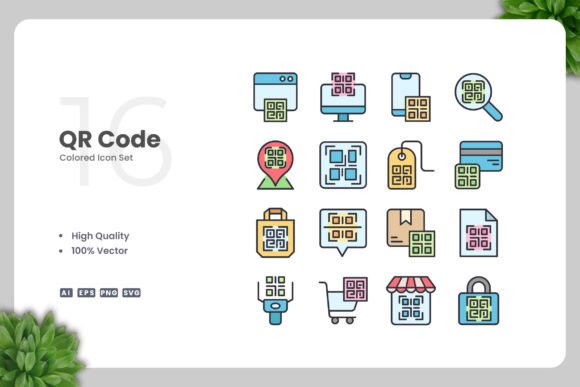
QR codes have evolved far beyond their original black-and-white matrix form. Today, QR Code Colored Icons represent a shift toward more engaging, brand-aligned, and visually coherent design. When you combine color with icon clarity, you get a graphic element that feels intentional rather than intrusive. This is especially relevant for professionals and creators who need materials that look polished across print, digital, and mobile contexts.
The idea behind colored QR code icons is straightforward: instead of a stark monochrome square, the code is rendered in hues that match a brand palette, a campaign theme, or a specific visual mood. The icons embedded within or around the code further reinforce the message. A simple, clean design approach ensures that the QR code remains scannable while looking like a natural part of the layout.
Why Color and Icon Integration Matters for QR Codes
Color affects how people perceive information. When a QR code uses color thoughtfully, it signals that the content behind it is worth engaging with. A muted pastel palette might suggest calm utility, while vibrant gradients can evoke energy and innovation. The key is maintaining enough contrast for scanners to read the code reliably. Modern scanning algorithms handle colored codes well, provided the foreground and background differ sufficiently in luminance.
Icons add another layer. A small envelope icon near the code tells the user "scan to send an email" without a single word. A shopping bag icon hints at a product page. This combination of QR Code Colored Icons reduces cognitive load because the visual cue is immediate. In a world where attention spans are short, that directness matters.
From a design perspective, embedding icons directly into the code or placing them as adjacent elements requires precision. The icon must not interfere with the code's error correction zones. Clean vector design solves this elegantly, as every element can be aligned mathematically.
The Role of Vector Format in QR Code Design Workflow
Vector graphics are indispensable when working with QR codes that need to scale across different media. Unlike raster images, vectors preserve sharp edges and solid color fills at any size. This is critical for QR codes because even slight blurring can cause scanning failures. A vector file containing QR Code Colored Icons can be resized from a business card to a billboard without degradation.
Software like Adobe Illustrator and CorelDRAW allows designers to open vector QR code files, ungroup elements, and modify individual modules. Changing a color from cyan to coral takes seconds. Replacing an embedded icon with a custom symbol is a matter of dragging and dropping. For teams that produce multiple campaign assets, this efficiency is invaluable.
Working with vector files also simplifies exporting for different platforms. You can produce an SVG for web use, a PNG with transparency for social media, and an EPS for print. The same source file serves all these outputs, ensuring consistency across touchpoints.
Understanding File Types and Their Practical Use
An Ai file (Adobe Illustrator) is the primary editable source. It retains all layers, paths, and color swatches. When you purchase or download a set of QR code icons, the Ai file gives you complete control. You can adjust the code's color, swap icons, or add effects like drop shadows while keeping the code scannable.
EPS Version 10 is a widely compatible format that opens in many vector editors, including older software versions. It's a safe choice for collaborative workflows where team members may use different tools.
SVG files are ideal for web and app use. They load fast, scale infinitely, and can be styled with CSS. For developers embedding QR codes into responsive interfaces, SVG is the most flexible option.
PNG with transparency serves as a ready-to-use raster format. It works well for social media graphics, flyers, and presentations where you don't need to edit the code further, but you want a clean background.
The presence of a Readme.txt file in a well-organized asset package explains any font dependencies, color codes, or usage notes. This small document can save time when handing off files to a printer or developer.
Websites and Mobile Apps
On a website, a colored QR code icon can be placed in a footer or alongside a call-to-action button. It offers an alternative way for mobile users to access a page without typing a URL. In mobile apps, QR codes are sometimes used for in-app referrals or quick feature access. Clean vector icons ensure the code renders crisply on high-DPI screens.
Print Materials
Flyers, brochures, and posters benefit from colored QR codes that harmonize with the overall design. A bright orange code on a white background draws the eye without clashing. For business cards, a subtle gray or metallic-toned code can feel premium. When printing, vector source files allow you to adjust the color to match Pantone swatches exactly.
Social Media Graphics
Social media posts that include QR codes need to stand out in crowded feeds. Using colored icons with a clean layout makes the code more likely to be scanned. An Instagram story with a QR code that uses brand colors and a simple icon can drive traffic to a product launch or event registration page.
Infographics and Educational Content
Educators and researchers use QR codes in infographics to link to extended data, video explanations, or source documents. A well-designed colored icon makes the code feel like part of the infographic's visual language, not an afterthought. This is particularly useful for printed handouts where space is limited and every element must earn its place.
Books and Publications
In textbooks and reference guides, QR codes can link to interactive content. Using colored icons that match the book's interior design creates a cohesive reading experience. Because the code is vector-based, it prints cleanly at small sizes without pixelation.
Banners and Posters
Large-format displays demand bold visuals. A QR code that spans several feet needs to be sharp. Vector files ensure that the edges remain crisp, and color can be chosen to contrast with the banner background. An icon inside the code can hint at what the user will find, reducing hesitation.
Customization Workflow from Source to Final Output
Having a structured workflow helps avoid common mistakes when customizing QR Code Colored Icons. Start by opening the Ai file in Illustrator. The layers should be labeled clearly: background, QR code modules, icon, and optional decorative elements.
First, adjust the QR code color. Select the modules and apply a new fill. For scannability, keep the foreground modules darker than the background. A good rule is to maintain a contrast ratio of at least 3:1. If you choose a light blue foreground, pair it with a white or very pale background.
Next, examine the icon. If the set includes a generic icon like a phone or link, you can replace it with a custom symbol. Drag your own vector icon into the file and position it over the center of the code. Avoid covering the three corner finder patterns, as those are essential for scanning.
After editing, test the code with a scanner app before finalizing. Different lighting conditions and screen types can affect readability. It is better to catch issues in the design phase than after printing.
When exporting, choose the format based on the use case. For web, SVG is transparent and lightweight. For print, EPS or high-resolution PNG works well. The Readme.txt file often includes notes on optimal export settings.
Quality Indicators in Colored QR Code Icon Sets
High-quality vector sets share several characteristics. The paths are clean without unnecessary anchor points. Colors are applied as global swatches, making global updates easy. The icon is centered precisely, and the QR code modules are uniform. These details matter because they affect how the code is perceived and how reliably it scans.
A well-designed set also accounts for the quiet zone, the empty margin around the code. When colors are applied, the quiet zone should remain neutral to avoid confusion with the code's modules. Most professional sets include at least a four-module-wide quiet zone.
Another quality marker is the inclusion of multiple color variations or themes. Some sets offer monochromatic, duotone, and full-color options within the same file. This gives the designer flexibility without needing to start from scratch.
Who Benefits from Using Colored QR Code Icons
Business owners who want their marketing materials to feel polished and consistent benefit directly. A flyer with a black-and-white QR code can look unfinished, while the same flyer with a colored icon version appears professionally designed.
Graphic designers and creative professionals gain efficiency by starting from a clean vector base. Instead of spending time building a QR code from scratch, they can focus on composition and messaging.
Educators and researchers appreciate the ability to create handouts that are both informative and visually engaging. A colored QR code that matches the handout's color scheme feels integrated rather than added as an afterthought.
Hobbyists and small creators who design their own social media graphics or event materials also benefit. The barrier to entry is low because vector files are easy to modify even with basic software skills.
Agencies and print shops that handle large volumes of materials value consistency. Having a source file that can be adapted for different clients saves time and reduces errors.
Observations on Trends and Practical Considerations
One trend worth noting is the use of gradient QR codes. While gradients can look striking, they require careful handling because scanners interpret color as luminance. A gradient from dark blue to light blue might cause the lighter parts to be misread. Testing is essential.
Another observation is that animated QR codes are gaining traction in digital contexts. While static vector files are the starting point, some designers export QR code icons as GIFs or SVG animations for social media. The same clean vector base works for both static and animated versions.
When designing for international audiences, consider that QR code scanning is more common in some regions than others. However, with smartphone cameras now including built-in QR readers, usage is growing globally. A well-designed QR Code Colored Icons asset works across cultural contexts because the visual language is universal.
Accessibility is another dimension. Color choices should accommodate users with color vision deficiencies. Avoid relying solely on red-green distinctions. Instead, use luminance contrast and shape differentiation where possible.
Bringing It All Together in a Clean Design Approach
Clean design is about removing the unnecessary while preserving function. For QR codes, this means choosing colors that serve a purpose, icons that communicate clearly, and layouts that respect the code's technical requirements. The result is a graphic that works as hard as the link it contains.
Whether you are designing for a mobile app, a printed book, a social media campaign, or an infographic, starting with a vector set of QR Code Colored Icons gives you a reliable foundation. The ability to resize, recolor, and re-export without quality loss makes this approach suitable for a wide range of deliverables.
In practice, the difference between a generic QR code and a customized icon version is often the difference between a user glancing past it and pausing to scan. That split-second decision can matter a great deal in engagement metrics and user experience.
Ultimately, the goal is to make the QR code feel like a natural part of the design language, not a technical necessity. Colored icons, executed with clean vector precision, achieve exactly that.