Privacy Colored Icons: A Strategic Resource for Clear and Consistent Visual Communication
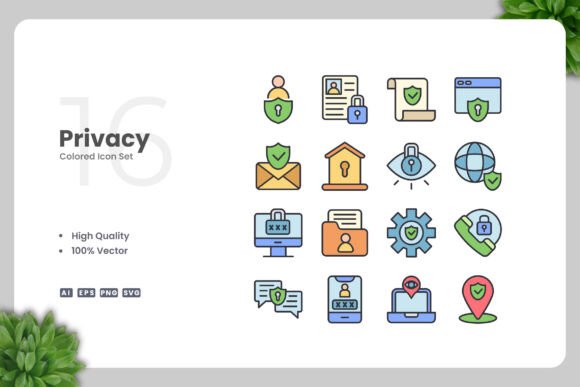
In any professional setting—whether you are launching a product, refining a brand identity, or creating educational material—the visual language you choose carries meaning long before a single word is read. Icons, when selected and applied with intention, become silent ambassadors of your message. Privacy Colored Icons offer a thoughtful balance between clarity and discretion, providing a versatile system that works across multiple platforms without demanding unnecessary attention. Designed with simplicity and clean lines, this icon set is built to serve a variety of practical needs, from website interfaces to printed collateral.
Why Visual Consistency Matters for Your Goals
Every decision you make about your visual assets either strengthens or fragments your communication. Consistency in iconography helps your audience recognize patterns quickly, reducing cognitive load and improving comprehension. When you rely on a unified set like Privacy Colored Icons, you eliminate the visual noise that often comes from mixing different styles or sources. This consistency supports your broader goals—whether those are marketing a service, streamlining an app interface, or creating training manuals—by ensuring that every visual element reinforces the same professional tone.
Consider the time you spend aligning your team around a shared visual vocabulary. Using a single icon set that is both high-quality and flexible means fewer revisions, less back-and-forth with designers, and a more cohesive end result. For entrepreneurs and small business owners who operate lean teams, this efficiency translates directly into faster turnaround and more predictable outcomes.
Aligning Icon Selection with Strategic Objectives
Before you choose any icon set, reflect on the core message you need to convey. Privacy Colored Icons, with their muted yet distinct palette, are particularly effective when you want to indicate status, categories, or actions without the distraction of overly bright or mismatched colors. If your product involves user data controls, security features, or level-based permissions, these icons signal privacy without being alarmist. They help users understand boundaries and options in a calm, professional manner.
For example, a mobile app that manages personal health records benefits from icons that feel secure and unintrusive. Using Privacy Colored Icons for features like “share with provider” or “lock record” reinforces trust. Similarly, in a dashboard for team collaboration, color-coded icons can indicate project visibility levels (private, shared, public) without relying on lengthy labels. The strategic use of color here becomes a functional shortcut for decision-making.
Practical Applications Across Media and Roles
One of the strongest arguments for investing in a vector icon set like this one is its adaptability across different contexts. Whether you are designing a presentation, an infographic, a flyer, or a social media post, the same icon file can be resized and recolored without losing quality. This flexibility is not just a convenience—it is a strategic advantage when you need to maintain brand coherence across diverse channels.
- Websites and mobile apps: Use Privacy Colored Icons to guide navigation, indicate user permissions, or visually separate content sections. Their clean design ensures readability on both small screens and large monitors.
- Books and reports: In printed materials, icons break up text and draw attention to key takeaways, especially in sections about data handling or privacy policies.
- Social media and infographics: A consistent icon style makes your visual content more shareable and easier to understand at a glance.
- Flyers, posters, and banners: Because the icons are vector files, you can scale them for billboards or business cards without distortion.
For educators and trainers, these icons offer a simple way to create learning aids that feel professional yet approachable. When you are building a course module on digital privacy or data ethics, having a set of icons that visually represent different concepts—encryption, consent, anonymization—helps learners anchor abstract ideas to a concrete visual.
How to Adapt and Customize Privacy Colored Icons for Your Brand
The true power of vector-based icon sets lies in their customizability. If you have access to Adobe Illustrator, CorelDRAW, or any compatible vector software, you can change colors, stroke weights, and sizes in seconds. This means you are not locked into someone else’s palette—you can align the icons with your existing brand guidelines. For example, you might keep the privacy theme but shift the colors to match your company’s primary hues, creating a seamless look across all materials.
When planning your customization, start with a clear vision of how the icons will be used. Will they appear on dark backgrounds? Do they need to be legible at very small sizes? Test the icons in the environments where they will actually appear. A common oversight is to finalize icon colors while viewing them only at full size on a bright monitor, only to find they lose contrast in a printed brochure or on a mobile screen. Use the included SVG and PNG files to prototype quickly across devices and outputs before committing to a full set.
Strategic Considerations Before Relying on Any Icon Set
While a cohesive icon library is a valuable asset, it is not a substitute for thoughtful content strategy. One risk of using any icon set without clear goals is that the visual elements may convey meaning that conflicts with your intended message. For example, if you use a lock icon to indicate privacy but the accompanying copy suggests the feature is optional, users may misinterpret the level of protection. Always pair icons with consistent labeling, and test your designs with a small sample of your target audience to verify comprehension.
Another risk is over-reliance on a single style. While Privacy Colored Icons suit many applications, you may find that certain industry contexts demand more literal or universally recognized symbols. If your audience includes older adults or people with low digital literacy, ensure that the icon’s meaning is immediately clear without cultural assumptions. Simple, clean designs generally perform well, but it is wise to confirm through usability testing.
Finally, avoid treating icons as decorative afterthoughts. When you insert an icon solely to fill white space or because “it looks nice,” you risk diluting your message. Instead, let each icon earn its place by supporting a specific function—clarifying a status, highlighting a call to action, or categorizing information. This discipline turns a design asset into a strategic tool.
Planning Your Visual Ecosystem with Privacy Colored Icons
To get the most out of this icon set, approach it as part of a larger visual ecosystem. Begin by mapping out the touchpoints where icons will appear: your website navigation, mobile app interface, email templates, slide decks, and any print materials. For each touchpoint, decide which actions or concepts need icon support. Then, within the Privacy Colored Icons library, select the symbols that best match those concepts. Because the set includes 100 vector files, you have enough variety to cover most common use cases while staying within a consistent visual family.
Document your icon decisions in a brief style guide. Note the approved colors, sizes, and any modifications you have made. This documentation becomes invaluable when you onboard new team members or contract external designers. It also ensures that if you later need a new icon, you can create or commission one that fits the existing style.
Long-Term Value and Adaptability
One of the less obvious benefits of investing in a high-quality vector icon set is its longevity. Because vector files are resolution-independent and easily editable, they remain useful as your brand evolves. You can repurpose the same icons for years, updating only the color palette or scaling them for new formats. This reduces the need to reinvent your visual language with every marketing campaign or product update. For freelancers and small business owners who work with limited budgets, this durability represents a smart allocation of resources.
Moreover, the inclusion of source files such as .AI and .EPS version 10, along with SVG and transparent PNG, means you are not locked into a specific software ecosystem. You can hand off files to collaborators who use different tools, and the icons will retain their quality. The provided Readme.txt file offers basic instructions, making the set accessible even if you are not a design expert.
Making the Decision: Is Privacy Colored Icons Right for Your Project?
No single icon set is perfect for every context, but Privacy Colored Icons are a strong candidate when your priorities include clarity, professionalism, and ease of customization. Evaluate whether your project demands icons that communicate nuanced statuses or permissions without shouting for attention. If you frequently create materials that need to feel trustworthy and clean—especially in privacy-sensitive areas like healthcare, finance, or legal services—this style is likely a good fit.
Before purchasing or downloading, think about the scale of your project. If you only need a handful of icons for a one-time presentation, a full library may be more than necessary. However, if you anticipate using icons repeatedly across multiple platforms, the convenience of having a unified, editable set ready at hand will save you time and reduce inconsistency. The upfront effort of selecting and customizing your icons pays dividends in the consistency of your brand’s communication over months and years.
Ultimately, the value of any design asset is determined by how intentionally you deploy it. Privacy Colored Icons give you a reliable foundation, but the strategic choices you make around color, context, and message alignment will determine whether your visuals support or undermine your goals. Use the flexibility of the vector files to test different approaches, listen to feedback from your audience, and refine your visual language as you go. That iterative, thoughtful process is what turns a good icon set into a lasting part of your communication toolkit.