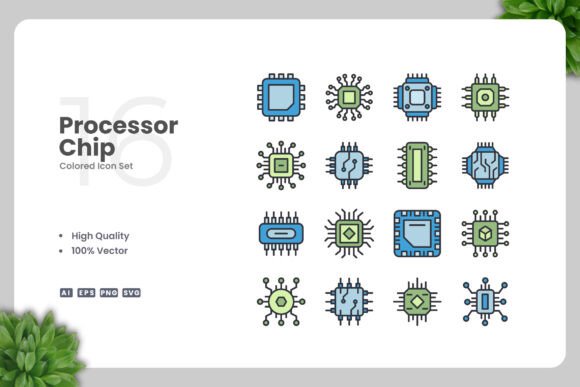
Designing with Processor Chip Colored Icons: Versatility in Visual Communication
In an era where digital and print media demand clarity and speed, the visual representation of complex technology through icons has become indispensable. Among these, the processor chip colored icon stands out not merely as a decorative element but as a functional marker of computing power, intelligence, and digital transformation. Designers, educators, marketers, and developers alike have recognized the value of these icons in conveying ideas without the clutter of text. The appeal lies in their ability to translate the abstract concept of processing capability into an instantly recognizable graphic that works across mediums—from a smartphone interface to a poster on a bulletin board.
What makes processor chip colored icons particularly effective is their adaptability. Unlike monochrome symbols that may blend into a design or fail to capture attention, colored icons introduce a layer of meaning through hue. A blue processor chip can evoke reliability and efficiency, while a red or orange chip suggests speed or high performance. Green might indicate eco-friendly or energy-saving processing. This color-based communication adds a psychological dimension to the icon, helping audiences grasp nuances at a glance. Designers working with vector formats like Adobe Illustrator or CorelDRAW find that these icons are fully customizable—they can resize them without losing fidelity, change colors to match brand guidelines, or adjust stroke weights for consistency across a project.
Core Characteristics of High-Quality Processor Chip Colored Icons
When evaluating processor chip colored icons for a project, several characteristics determine their usefulness. The first is clarity. A well-designed chip icon should immediately read as a processor—featuring a square or rectangular die, often with pins, traces, or a grid pattern that suggests circuitry. The inclusion of color must enhance, not obscure, these identifying features. The second characteristic is scalability. Because these icons appear in contexts ranging from tiny mobile app buttons to large banners, they must remain legible at any size. Vector formats such as AI, EPS, and SVG ensure that scaling does not introduce pixelation or blurring. A 100-vector design means each icon is constructed from mathematical paths rather than pixels, allowing infinite resizeability. The third characteristic is cohesiveness. In a set of icons, each processor chip symbol should feel like part of a family—consistent in line thickness, corner radius, color palette, and level of detail. This consistency is what separates professional icon sets from amateur collections.
Another important attribute is the file format support. Modern workflows require flexibility. A designer might need a PNG with transparency for a website, an SVG for interactive prototyping, or an EPS version 10 for compatibility with older vector software. High-quality icon sets include all these formats, along with a source file (Ai) for deep editing. This ensures that whether the user is a seasoned graphic designer or a hobbyist creating a flyer, they can open the icon in their preferred software and make adjustments. The inclusion of a readme.txt file further helps users understand the contents and licensing, which is especially valuable for commercial projects.
Practical Applications Across Media
The versatility of processor chip colored icons becomes apparent when examining their use across different types of media. In website design, these icons serve as visual anchors for sections about technology, computing, or digital services. A hero image featuring a glowing processor chip icon can immediately communicate that the site is about hardware, software, or IT solutions. On mobile apps, colored chip icons are used in navigation bars, onboarding screens, or as part of infographics within the app. Their small footprint means they do not overwhelm the interface, yet their color adds a touch of personality. For books and educational materials, processor chip colored icons illustrate concepts related to computer architecture, data processing, or the Internet of Things. A textbook might use a row of chip icons in different colors to represent different generations of processors, making the content more engaging for students.
Social media graphics benefit greatly from these icons. A tweet or Instagram post about a new processor launch can be accompanied by a vibrant chip icon that draws the eye in a crowded feed. Infographics, which rely on visual hierarchy, use processor chip colored icons to label data points or to represent processing speed, memory, or efficiency in a chart. In flyers and print banners, these icons often serve as headers or bullet points. For example, a tech conference flyer might list its topics with processor chip icons next to each session title, instantly signaling that the content is technical. Posters for workshops or product launches use larger versions of the icons as central visual elements, with the color scheme matching the event branding. In each case, the icon performs the dual function of decoration and communication.
Customization Workflows in Vector Software
One of the strongest selling points of processor chip colored icons is their ease of customization. Working in Adobe Illustrator or CorelDRAW, a designer can open the source Ai file and immediately access every component of the icon. Because the icons are 100 vector and 100 customizable, any aspect can be changed. Need the chip to match a specific brand blue? Simply select the shape and apply a new swatch. Want to use only outlines for a minimalist look? Adjust the fill to none and increase the stroke weight. The drag-and-drop nature of these files means that even users with limited vector experience can simply place the icon onto their artboard and resize it instantly. For more advanced users, the EPS version 10 format offers backward compatibility while retaining all editing capabilities.
The PNG transparency file included in the set serves as a ready-to-use option for those who do not have vector software or who need a quick asset for a presentation. However, the real power lies in the vector source. Consider a scenario where a marketing team needs a consistent set of processor chip icons for a global campaign. Using the source file, they can create a master icon and then generate variations by changing colors for different regions—perhaps red for Asia, blue for Europe, and green for sustainability initiatives. This kind of flexibility would be impossible with raster images. Furthermore, SVG files allow web developers to embed icons directly into HTML and CSS, enabling them to control color and size through code. This makes processor chip colored icons equally useful for print designers and front-end developers.
User Groups and Their Distinct Needs
Different audiences approach processor chip colored icons with different expectations. Professionals such as graphic designers and art directors prioritize aesthetic precision and brand alignment. They need icons that are not only technically sound but also visually striking. For them, the ability to tweak every curve and shadow is essential. Consumers and business owners, on the other hand, may use these icons for marketing materials or internal presentations. They value ease of use and professional appearance without needing to learn complex software. The availability of multiple file formats ensures that they can drop the icon into a PowerPoint slide or a social media post with minimal effort. Creators and hobbyists often look for inspiration. A well-designed icon set can spark ideas for their own projects—whether it is a YouTube channel logo, a podcast cover, or a custom t-shirt design. Having a high-quality set at their disposal saves them time and raises the quality of their work.
Educators and researchers use processor chip colored icons to make complex topics more approachable. A professor teaching computer science can use these icons in lecture slides to visually represent concepts like clock speed, cache, or multi-core processing. The color coding helps students remember distinctions. For researchers presenting at conferences, these icons add a layer of professionalism to posters and handouts. The academic audience values clarity and accuracy; an icon that looks like a real processor chip, but with artistic simplification, is ideal. It bridges the gap between technical precision and visual communication.
Considerations for Selection and Implementation
While processor chip colored icons are highly versatile, certain considerations can improve their effectiveness. The first is the style. Some icon sets are flat and minimalist, while others use gradients, shadows, or 3D effects. The choice should align with the overall design language of the project. A clean, simple design is generally the safest choice because it works across more contexts and ages well over time. Another consideration is the number of icons in the set. A set with multiple variations of the same chip—different angles, with or without pins, different color variants—provides more flexibility. However, even a single well-crafted icon can be sufficient if the source file is fully editable. The color palette also matters. Icons that use standard primary or secondary colors are easier to match with existing branding than those with unusual or overly saturated hues.
File organization is another practical factor. A well-structured set with clear naming conventions and a readme file helps users locate what they need quickly. For teams working under tight deadlines, this can save significant time. Additionally, licensing terms should be reviewed. Commercial projects require icons that are either royalty-free or come with a clear usage license. The readme.txt file included in the set should specify this information. Finally, consider the future. As design trends evolve, icons that are too stylized may become dated. Opting for a timeless, simple design for processor chip colored icons ensures that they remain useful for years, whether in print, on the web, or in mobile apps.
Trends and Evolving Visual Language
The visual representation of technology icons has evolved significantly in the past decade. Early processor icons were often monochrome and highly detailed, mimicking the actual appearance of a CPU. Today, the trend leans toward simplification and abstraction. A modern processor chip colored icon might reduce the chip to a clean square with a few lines or dots representing pins, using color to add character. This shift reflects a broader design philosophy that prioritizes user experience over technical accuracy. In infographics and social media, where attention is fleeting, a simple icon communicates faster. The use of color has also become more strategic. Brands now use specific color systems that align with their identity, and processor chip colored icons are often part of a larger icon set that shares a consistent palette. This creates a cohesive visual ecosystem across a company's communications.
Another trend is the integration of these icons into animated or interactive content. While the icons themselves are static, designers use them as starting points for animations in video intros, website loaders, or app transitions. Because the icons are vector-based, animators can rotate, scale, or color-shift them smoothly. The SVG format, in particular, supports CSS animations, allowing web developers to create interactive elements without heavy performance costs. This opens up possibilities beyond traditional print and static digital use, making processor chip colored icons relevant for modern web experiences.
Practical Example: Building a Tech Infographic
Consider a practical scenario to illustrate the utility of these icons. A data analyst wants to create an infographic comparing processing speeds across different generations of smartphones. Using a set of processor chip colored icons, they can assign each generation a distinct color—blue for the first generation, green for the second, yellow for the third, and red for the latest. The icons are placed next to each data point, creating an immediate visual correlation between the color and the performance metric. The analyst opens the Ai source file, changes the colors of the icons to match the chosen palette, and resizes them uniformly. The PNG transparency files are used for quick placement in the infographic software. The result is a professional, easy-to-read infographic that communicates data at a glance. Without the icons, the infographic would rely solely on text and numbers, making it less engaging. The processor chip colored icons transform the presentation from a dry report into a visual story.
In another example, a web designer working on a tech startup's landing page uses a large processor chip colored icon as the focal point of the hero section. Behind the icon, a subtle gradient background picks up one of the colors from the icon, creating a harmonious visual. The icon is linked to the SVG file for optimal performance across devices. As the user scrolls, the icon remains in the background at a fixed position, reinforcing the brand's association with technology and innovation. The simplicity of the icon ensures that it does not compete with the call-to-action buttons or text. Instead, it supports the overall narrative. These examples show the power of thoughtful icon implementation.
Final Thoughts on Workflow Integration
Integrating processor chip colored icons into a workflow is straightforward when the file formats are well organized. Designers can start by importing the EPS version 10 file into their vector software for editing, then export the customized icon to the required format. For web projects, the SVG file is ideal because it maintains quality at any screen resolution and can be styled with CSS. For print, the Ai file offers the highest fidelity, and the PNG transparency file serves as a quick preview or for use in less demanding software. The readme.txt file acts as a quick reference guide, listing the contents and any usage notes. With these resources, the user can focus on the creative aspects rather than technical troubleshooting.
Ultimately, the value of processor chip colored icons lies in their ability to communicate complex ideas simply and beautifully. Whether you are designing a mobile app, writing a textbook, creating a social media campaign, or producing a printed banner, these icons provide a reliable, customizable visual tool. By choosing a set that offers high quality, full vector customization, and a range of file formats, you ensure that your project benefits from professional visuals that are both functional and aesthetically pleasing. The combination of color and clean design makes processor chip colored icons a staple in the toolkit of anyone who communicates about technology. With the ability to resize, recolor, and adapt them to any medium, they remain a timeless asset in an ever-changing design landscape.